
You're in the right place! Whether in nature, in the middle of the city, for families, in the countryside, historic or traditional: among Thuringia's TOP hosts, everyone will find exactly the right address.
Theatre and heartbeat of the city
Weimar
Theatre has been an essential part of Weimar's cultural identity since the age of Goethe and Schiller. The best bit: from opulent Faust productions in the German National Theatre to more light-hearted plays in an intimate setting and open-air events in the great outdoors – there is something for everyone. Weimar is the best place to combine theatre with culture and city experience.
Weimar means world heritage in a combination of classical, modernism and Bauhaus. But let’s not forget that it stands for theatre tradition as well. After all, the stages of the German National Theatre (DNT) – opened by Johann Wolfgang von Goethe as court theatre in 1791 - are among the most important in Germany with their operas, plays and concerts. In the 'city of poets and philosophers', theater is not a museum-like duty to continue, but rather a a ‘vibrant part of everyday urban life’, as the new co-director Valentin Schwarz puts it. Surrounded historical façades, parklands and student life (The city is home to two educational institutions with the Bauhaus University and the University of Music.) a theatre landscape thrives that preserves tradition to pass it on to future generations, and not just keep it as a time-frozen entity. The German National Theatre with its prestigious Great House – high ceilings, ornate boxes, magnificent chandeliers – is the most prominent venue of all. The building on the central theatre square with the frequently photographed Goethe-Schiller monument out front seems like a symbol for the role that theatre play in Weimar. The Weimar National Constitution was adopted here in 1919; a political act that entered the annals of history. But it was still an establishment devoted to Goethe, who, in his role as artistic director, coined the idea that art should be educational and moving. This idea continues to reverberate today, albeit in a contemporary form. “Transforming old treasures into new theatre!” is how 36-year-old Schwarz sums up the DNT mission. And one more: “We want our programme to reach as many different people as possible, especially those who have never attended a theatre performance before.”
⠇
So how does that work? The answer includes fresh formats such as the Open Foyer, which transforms the theatre into a meeting place – during the day, free of charge, without any hint of consumerism. Everyone is invited to chat over coffee and cake, play games, read, knit or do yoga and ‘get a taste of the theatre as the day unfolds’. Another example is the DNT Salon, in which discussion, reading and performance formats are often shorter and more dialogue-based than in classical theatre evenings. After all, parties, film nights and theme evenings are aimed specifically at people under 30.
The city as a stage
But the programme still remains firmly embedded in tradition: opera, theatre, ballet and concerts – the Staatskapelle is considered one of the most richly traditional in Germany – are equal parts of the programme, often reinterpreted and surprisingly topical as well. The stages feature classics such as Faust or Wallenstein alongside contemporary material, social debates and aesthetic experiments. At the DNT venues – which also include the Weimarhalle, the Studiobühne and the Redoute – theatre and classical music present themselves as life forces and not merely as inevitable parts of the repertoire.
⠇

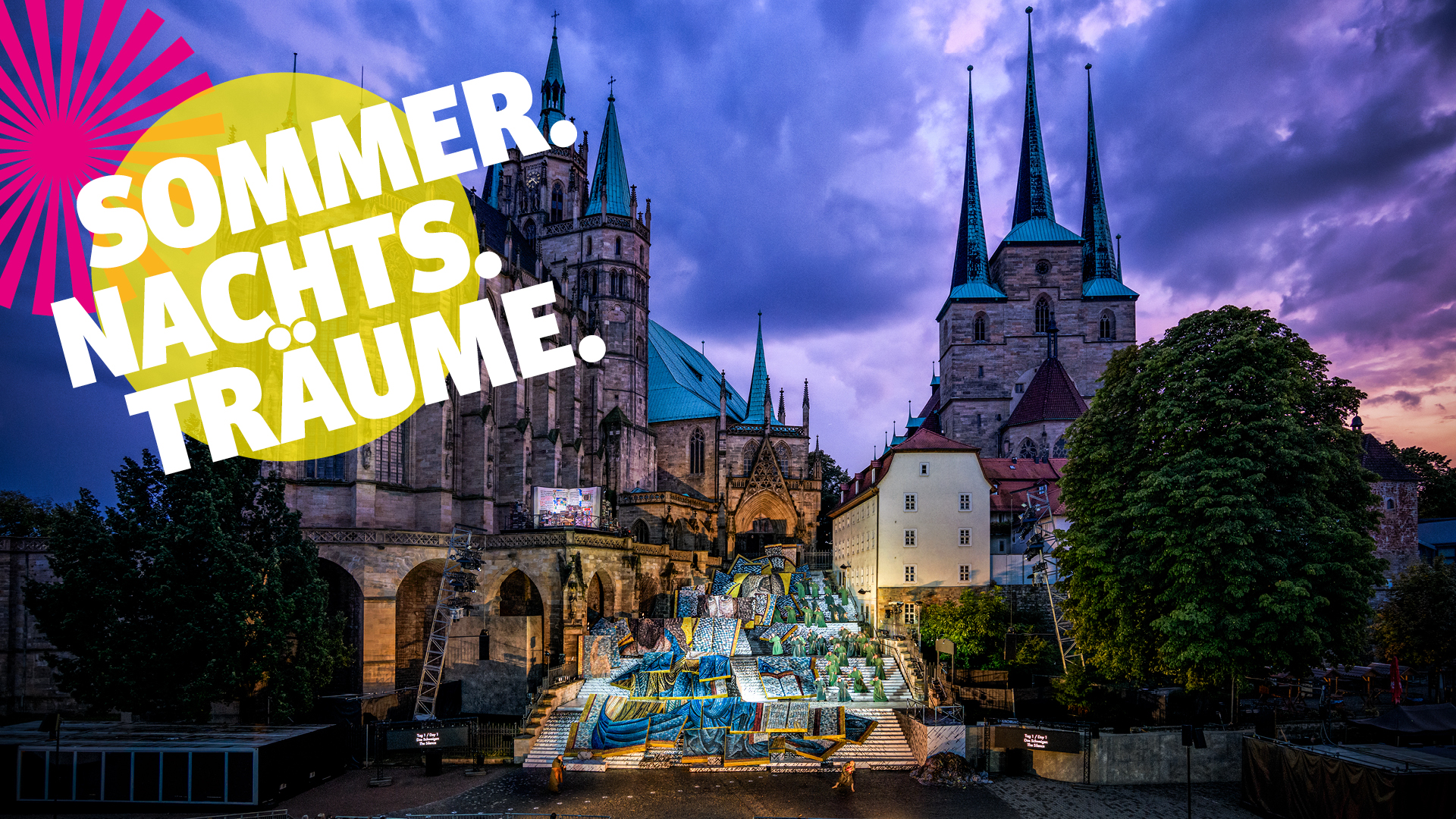
Indeed, this blend of being rooted in history and having a firm place in the present describes how the inhabitants of this city of 65,000 inhabitants see themselves. This becomes even more apparent when between June and August the theatre 'steps out' into the city and the great outdoors. The Weimar Summer – a festival lasting for several months and held since the mid-2010s – transforms squares, parks and industrial wastelands into joyful venues. Even the city itself becomes a stage for open-air performances, concerts, readings and performative formats. “Places are filled with the art of theatre – although their original purpose was entirely different”, says Schwarz. Among them is the E-Werk an der Ilm, which this year will stage Molière's The Misanthrope as a baroque summer spectacle from early June to the beginning of July, all of it against the unique backdrop of industrial architecture and a natural landscape. Or the Weimarhallenpark, which on 4 July will mutate into an open-air venue for a concert night with the Staatskapelle Weimar in cooperation with weimar GmbH. The Stellwerk is another interesting venue for interdisciplinary, occasionally quite experimental productions in the former railway building. Schwarz describes the range of productions as follows: “The municipal theatre is becoming a theatre city!”
Enjoying art in a private setting
DNT is also a partner to the Weimar Art Festival, which will be led by a new artistic director from 2026. It is the largest festival for contemporary arts in eastern Germany and brings (musical) theatre and installations from all over the world to various Weimar locations – from the old town to the park on the Ilm. Visitors almost inevitably ‘stumble’ across illustrious figures rooted in local history, from Bach to Herder, Wieland and Liszt to Gropius, automatically creating a holistic city experience. First the Bauhaus Museum or the Nietzsche Archive, then the theatre? Nothing could be easier.
⠇
It is just a short stroll from the Goethe House to the Cranach House, where visitors can see what they have just learned in the Theater im Gewölbe, the ‘Theatre in the Vault’. "We specialise in Goethe and perform everything from Werther to Faust, sometimes with a humorous or even an erotic touch”, says Oleg Keiler, artistic director of the Theater am Markt, which was established as part of the Capital of Culture year in 1999. He now coordinates around 500 events in up to 30 productions each year. The classic-modern productions are informal – no more than three actors and 100 audience members – and often surprisingly topical crowd-pleasers. “Everyone actually has a front-row seat here”, says Keiler, referring to the airy seats and bistro tables as well as the excellent acoustics in the groin-vaulted auditorium. How about another tip to blend city history with contemporary theatre? Palais Schardt with its Goethe Pavilion is an exhibition and event venue that builds a bridge between literature, theatre, music and performative formats.
“Theatre is life!”
The private Galli Theatre, on the other hand, is definitely a Goethe- and Schiller-free zone. The cellar room is cosy, admission is inexpensive, and the content is easy to digest and humorous. Krispin Wich features in almost all productions, either as a solo recital or with a partner. “We operate with simple resources, but we put our heart and soul into everything we do”, says the 72-year-old theatre director, who is known for his unconventional methods. Lord Mayor Peter Kleine highlighted one of them on the 20th anniversary in 2025: “The work of the theatre is also enriching for children and young people, as it addresses the topics of addiction and violence. This kind of commitment demonstrates that art is more than just entertainment – but also a source of strength and assistance.” In line with this credo, Wich is also active as a hospital clown: “Theatre is life, theatre is communication!” Schwarz takes a similar view: “Theatre means people, not a building.” Bringing people together in a live setting is more important than ever before, not least as a means of strengthening democracy.
Cover: © Florian Trykowski
Restaurants
Nice to see
Top hosts nearby
Did you like this story?
e.g. zielgruppe_Sehnsucht
You might also be interested in ...

Sustainable Thuringia
Sustainability is on everyone's lips, and it is important. It's about us and our future, about a healthy environment, healthy people, a fair and just world for everyone. Come along and discover good examples in Thuringia – certified spots, sustainabel offers, national natural landscapes and more!


